

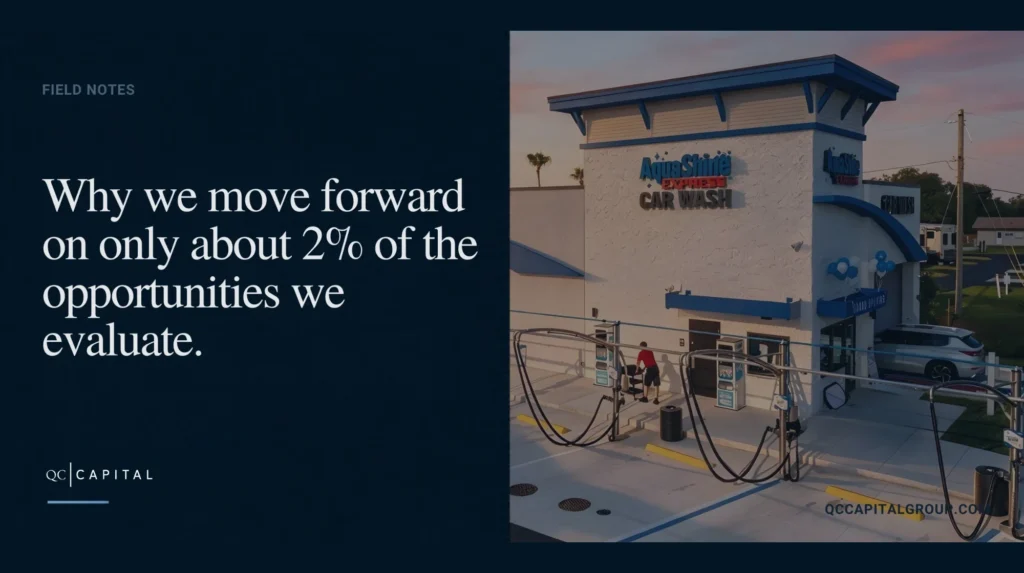
Ask most acquisition firms what they are looking for, and the answer is a description of a target: the market, the format, the growth profile. Ask QC Capital Group, and the answer starts somewhere else, with a description of everything the firm is prepared to walk away from.
The firm’s stated practice is to move forward on only about 2% of the opportunities it evaluates. That figure is not a marketing line, and it is not a hurdle rate maintained for its own sake. It is the output of a buy-box applied consistently, and it shapes nearly everything else about how QC operates, from which markets it enters to how its finished sites are run.
The rule itself is easy to state and hard to keep. When a deal fails the firm’s buy-box criteria, it does not proceed, regardless of how good the presentation looks. A polished deck, a motivated seller, a compelling narrative on the conference-room wall: none of it changes the underlying math if the site does not clear the bar. The criteria are treated as fixed, which means the volume of attractive-looking opportunities that never become QC deals is, by design, very large.
“Everyone in car care is talking about deal flow right now. We see the same deals, and we pass on almost all of them. Moving forward on about 2% of what we evaluate is not caution, it is the strategy. The deals that don’t meet our buy box aren’t losses, they’re proof the filter works,” said Chris Salerno, Founder and Chief Executive Officer of QC Capital Group.
Restraint gets tested hardest when the market around it is moving quickly, and the car wash sector is moving quickly. The consolidation wave that has reshaped the industry continued this fall: Take 5’s first and third franchisees recently combined to form FAST, now a 52-center operator, while Tidal Wave and Club Car Wash each made acquisitions of their own. When credible operators are actively aggregating sites, the pressure to transact is real, and so is the temptation to stretch on a deal simply to keep pace.
QC’s answer to that pressure is to hold the criteria rather than loosen them. The firm’s team takes the view that the market does not need QC to participate in every transaction, and that investors are better served by a smaller number of sites underwritten the right way than a larger number underwritten to fit the moment.
That restraint has been tested against results, too. Several deals QC passed on in 2026 were later congratulated in the press. The firm reads those outcomes the way an operator would: a deal that closes well for someone else is not evidence that it would have closed well for QC, at QC’s underwriting, with QC’s cost basis. Passing is not missing. The two look identical on the day of the decision, and they separate over the following years.
Underneath the discipline is a philosophy about what happens after closing. QC buys sites at conservative unit economics so that cost shocks and volume dips do not break trust at the menu board. The phrasing matters. An operator underwritten at aggressive assumptions has to raise prices or trim service the first time costs move against it, and customers feel that at exactly the moment the business was asking for their loyalty. An operator underwritten with room to absorb a difficult stretch keeps its promises during that stretch. QC would rather own the second kind of business.
None of this makes the firm passive. Running a 2% filter is, in some ways, more work than running a looser one, because it requires underwriting depth on a much larger pool of opportunities to find the few that clear it. It also requires the patience to walk away cleanly and return to a market later, which the firm has built across its acquisition history.
In a sector consolidating this quickly, restraint can look like caution. QC’s position is closer to the opposite: the discipline is the strategy. Buying only what clears the bar, at unit economics built to survive a bad year, is what allows the firm to keep its word to the customers at the menu board and the investors behind it, in good conditions and bad.
QC Capital Group, LLC is a Charlotte, North Carolina-based private equity and alternative investment firm founded in 2018. The firm acquires, builds, and operates real assets and operating businesses for accredited investors. Learn more at qccapitalgroup.com.
If you are an accredited investor or an advisor evaluating operator-led car care strategies, QC Capital’s team can walk you through how the platform is underwritten and run. Start a conversation with QC Capital. This article is for informational purposes only and is not an offer to sell or a solicitation of an offer to buy any security. Any offering is made only to accredited investors through a confidential private placement memorandum. Private investments are speculative and illiquid and involve risk, including possible loss of principal.