

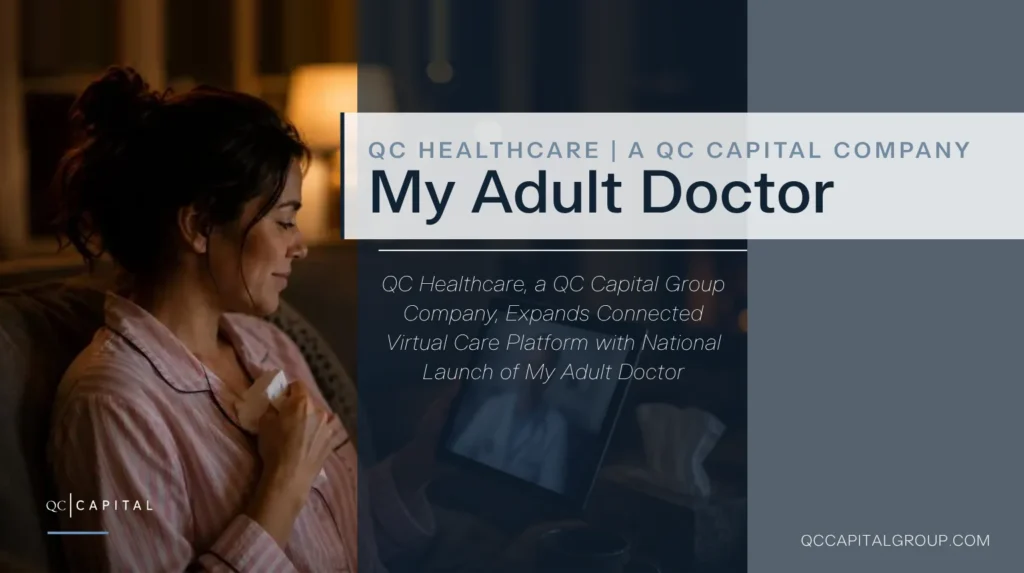
QC Healthcare, a subsidiary of QC Capital Group, has launched My Adult Doctor nationally, extending its connected virtual care platform to adult and specialty primary care. The service offers virtual visits with board-certified clinicians 24 hours a day, every day of the year, for patients across the United States, Puerto Rico, and Guam.
What Is My Adult Doctor?
My Adult Doctor is a virtual care service for adults, covering urgent, primary, and specialty care. QC Healthcare announced the national launch on October 29, 2026. It joins My Pediatric Doctor, the company’s national pediatric telehealth service, which launched nationally earlier this year.
How a visit works
According to My Adult Doctor’s website, a patient completes a short check-in, then speaks with a physician by video, phone, or chat. If medication is needed, the doctor sends a prescription electronically to the patient’s chosen local pharmacy. If the doctor decides an in-person exam or lab test is necessary, the service says it will tell the patient and help coordinate the next step.
Three ways to pay
Like My Pediatric Doctor, My Adult Doctor accepts insurance and fee-for-service payment. It also works with self-insured businesses to provide real-time health benefits for their employees. A self-insured, or self-funded, employer pays its workers’ health claims directly rather than buying a fully insured policy, and that arrangement is common: KFF’s 2026 employer survey puts 71% of covered workers in self-funded plans, including 85% at firms with 200 or more workers.
Why Adult Access Is the Target
QC Healthcare’s case for the launch rests on access. The release points to three gaps: appointment waits that stretch for weeks, emergency rooms absorbing visits that are not emergencies, and few options outside normal office hours.
“Access is the defining challenge in American healthcare, and it is one we can solve with technology that already exists,” said Eric Doherty, CEO of QC Healthcare. “My Adult Doctor brings the same connected, always-available care that families rely on through My Pediatric Doctor to adults across the country. This launch is a milestone in our mission to make high-quality care available to every patient, on their schedule, wherever they live.”
What the wait and cost data show
Independent data supports the general picture, though neither of these studies looked at My Adult Doctor:
- Appointment waits: AMN Healthcare’s 2025 survey of 15 large metro areas found an average wait of 23.5 days for a new-patient family medicine appointment, and 31 days across the six specialties it tracks.
- Emergency room costs: a Peterson-KFF analysis of 2019 large employer plan data found an average out-of-pocket cost of $646 per emergency department visit. Even the least complex visits averaged $205 out-of-pocket and $592 in total.
Where each care setting fits
Virtual care does not replace every other setting. It competes best on speed and convenience for problems that do not need hands-on care. The comparison below is general and is not medical advice.
| Dimension | Virtual visit | Primary care office | Emergency department |
|---|---|---|---|
| Availability | Can be around the clock, depending on the service | Usually scheduled during office hours | Open 24/7 |
| Common uses | Minor illness, refills, follow-up questions | Preventive care, physical exams, ongoing conditions | Serious or life-threatening problems |
| Physical exam and testing | Limited, so some patients are referred elsewhere | Exams on site, with testing varying by office | Full exam, imaging, and labs on site |
| Main limitation | No hands-on examination | New-patient waits can run for weeks | Often the highest cost for routine problems |
Anyone with a possible emergency, such as chest pain, trouble breathing, or signs of a stroke, should call 911 rather than start a virtual visit.
A Second Service on the Same Platform
The strategic point of the launch is reuse. My Adult Doctor runs on the same connected platform architecture as My Pediatric Doctor, and QC Healthcare says the two services let a family manage pediatric and adult care in one place, with the same clinical standards and around-the-clock availability.
“We are building a category-defining virtual care platform,” said Chris Salerno, Founder of QC Healthcare and Founder and CEO of QC Capital Group. “My Pediatric Doctor proved the model, and My Adult Doctor takes it to more patients who need it. Adults carry much of the country’s unmet need for timely care, and we are meeting it with a platform designed to scale nationwide.”
What comes next for QC Healthcare
QC Healthcare describes itself as a healthcare innovation holding company that builds, funds, acquires, and scales businesses across telehealth, specialty care, clinical research, pharmacy services, and related fields. Its website lists My VA Doctor, My Oncology Doctor, and My Vet Doctor as coming soon. It gives no launch dates for them, and plans of this kind can change.
A pattern across the QC Capital platform
Adding a related business to an existing platform also shows up elsewhere at QC Capital. The firm recently launched Cruz Express Oil, extending its car care portfolio from express car washes into quick-lube service. Healthcare and car care are very different businesses, and success in one says nothing about results in the other.
What to Watch as the Service Scales
A launch announcement shows that a service is available. It does not show how the service will perform. The release does not disclose patient volumes, revenue, or clinical outcomes, so it offers no measure of adoption yet.
These are the main questions to keep in mind about any national telehealth expansion:
- Adoption: whether adults, families, and employers use the service, and keep using it, in a field that already includes established telehealth providers.
- Payment: insurance coverage and reimbursement vary by plan and can change, which affects both what patients pay and what the service earns.
- Regulation: clinicians generally must be licensed where the patient is located, and telehealth and prescribing rules differ by jurisdiction.
- Quality at scale: keeping clinical standards and response times steady as visit volume grows.
Frequently Asked Questions
What is My Adult Doctor?
My Adult Doctor is a virtual care service from QC Healthcare, a subsidiary of QC Capital Group. It provides adult urgent, primary, and specialty care through virtual visits with board-certified clinicians, and it launched nationally as announced on October 29, 2026.
Where is My Adult Doctor available?
It is available across the United States, Puerto Rico, and Guam, with clinicians available 24/7, 365 days a year. You can find it at MyAdultDoctor.com.
Does My Adult Doctor accept insurance?
Yes. The service accepts insurance as well as fee-for-service payment, and it works with self-insured businesses. Coverage depends on your plan, so check with the service or your insurer before a visit.
How is My Adult Doctor related to My Pediatric Doctor?
Both are QC Healthcare services and run on the same connected platform. My Pediatric Doctor serves children and My Adult Doctor serves adults, so a family can manage both kinds of care in one place.
How is QC Healthcare related to QC Capital Group?
QC Healthcare is a subsidiary of QC Capital Group, a Charlotte, North Carolina-based private equity firm with a diversified portfolio spanning multiple industries. Chris Salerno is the founder of QC Healthcare and the Founder and CEO of QC Capital Group, and Eric Doherty is CEO of QC Healthcare.
If you are an accredited investor or an advisor who wants to understand how QC Capital builds and operates its businesses, the firm’s team can walk you through the platform. Start a conversation with QC Capital. This article is for informational purposes only. It is not medical advice, and it is not an offer to sell or a solicitation of an offer to buy any security. Any offering is made only to accredited investors through a confidential private placement memorandum. Private investments are speculative and illiquid and involve risk, including possible loss of principal. Past performance is not indicative of future results, and statements about business plans are forward-looking and may change.