

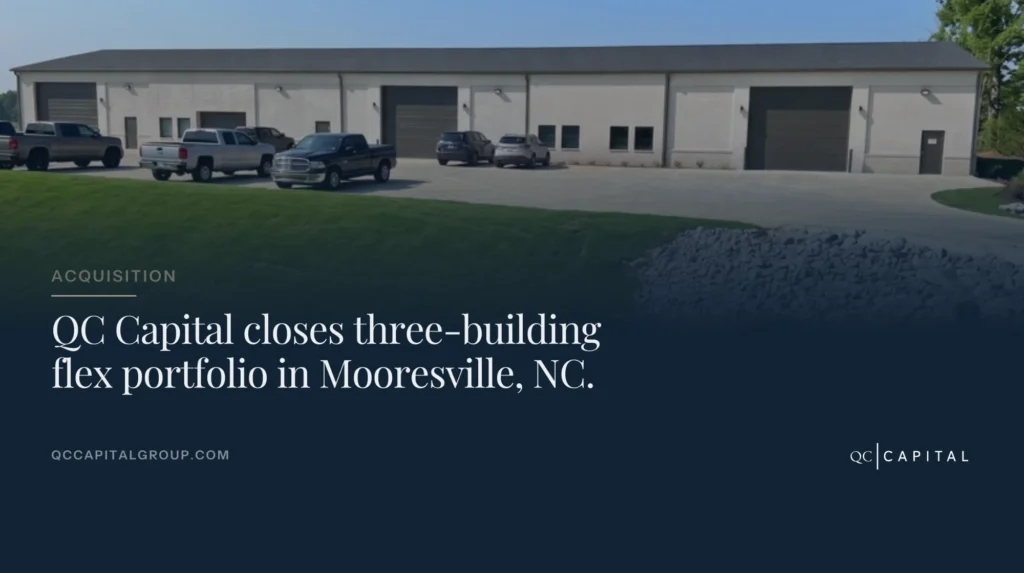
QC Capital Group has closed on a three-building flex industrial portfolio at 1005, 1045 and 1095 Packard Drive in Mooresville, North Carolina. The 28,822-square-foot property holds five flex units built in 2023 and 2024, was 100 percent occupied at closing, and sits in Iredell County, the fastest-growing county in the Charlotte metro.
The Mooresville Acquisition
On October 15, 2026, QC Capital Group announced that it closed the purchase of the Packard Drive portfolio on October 13. The property is held through an ownership entity, 1095PD LLC, and it adds five newly built, fully leased flex units to the firm’s growing flex industrial platform across the Carolinas.
What QC Capital bought
The portfolio is three buildings on a single street, totaling 28,822 square feet and divided into five flex units. Flex space (short for flexible industrial space) combines a small office or showroom area with a warehouse or shop bay behind it, usually served by a drive-in roll-up door. The format suits contractors, trades, light manufacturers, service businesses, and specialty suppliers that need a customer-facing front and working space in the back under one roof.
All three buildings were completed in 2023 and 2024, so the property is new construction by any industrial standard. Newer flex buildings typically need less near-term capital for roofs, HVAC, and paving than older stock, which lets an owner focus on leasing and operations instead of deferred maintenance.
Where it sits
Packard Drive is inside the Mooresville Motorsports Center, a business park that is home to race shops, fabricators, parts suppliers, and service businesses. Mooresville is known as “Race City USA” because of the dozens of NASCAR teams, race shops, and motorsports suppliers based there, and it is also the corporate home of Lowe’s Companies. That mix of specialty trades, suppliers, and service firms is the core tenant base for small-bay flex space.
Full occupancy on day one
The property was 100 percent occupied when the sale closed. For an investor, that means the asset produces rental income from the first month of ownership rather than waiting on lease-up. It also means the investment case does not depend on finding new tenants. It depends on running the property well and bringing rents toward market as leases come up for renewal.
The Business Plan: A Five-Year, Value-Add Hold
QC Capital intends to own the Packard Drive portfolio for about five years using a value-add approach. In real estate, value-add means improving a property’s income through better management, leasing, or targeted improvements rather than relying only on market appreciation.
Below-market rents
According to the firm, in-place rents at the property are below current market rates. That gap is common when a building is leased during construction or shortly after delivery, before an area’s rents have caught up, or when an owner prioritizes filling space quickly. As existing leases expire, an owner can renew or re-lease units closer to market rents, which raises net operating income without adding square footage. How much and how fast depends on lease terms, tenant renewals, and where market rents are when each lease rolls.
From owner management to a professional platform
The property is moving from owner management onto QC Capital’s professional management platform, the same operating systems the firm applies across its portfolio. Small flex properties are often run by the developer or a local owner who handles leasing, rent collection, and repairs personally. Moving to an institutional platform typically brings standardized leases, consistent rent reviews, preventive maintenance schedules, and regular reporting to investors.
Real estate paired with the businesses inside it
Flex industrial fits QC Capital’s broader strategy of pairing real estate ownership with the operating businesses that occupy it. In car care, QC Capital owns and operates the businesses directly through AquaShine Express and Cruz Express Oil. In flex, the firm owns the buildings that house local operating businesses, the trades and service companies that keep a growing region running. QC Capital describes both as investing in the infrastructure of daily life.
Why Mooresville and the I-77 North Corridor
Mooresville sits along the I-77 corridor in the Lake Norman region north of Charlotte, and the numbers behind the market are strong: Iredell County is the fastest-growing county in the Charlotte metro, and its industrial vacancy is a fraction of the metro average.
The Charlotte metro’s fastest-growing county
Iredell County, which includes Mooresville and Statesville, grew 2.8 percent between July 1, 2024 and July 1, 2025, adding 5,679 residents to reach an estimated 211,798, according to U.S. Census Bureau estimates reported by the Charlotte Business Journal and Iredell EDC. That was the highest growth rate of any county in the Charlotte metro and the fourth highest in North Carolina. Nearly all of the gain, 5,533 people, came from people moving in. The county had 186,686 residents at the April 2020 Census base, so it has added roughly 25,000 people in about five years.
Tight industrial vacancy
Iredell County’s industrial market is much tighter than the broader Charlotte market. In Cushman & Wakefield’s second-quarter 2026 Charlotte industrial MarketBeat, the Iredell County submarket reported overall vacancy of 2.8 percent across roughly 29.1 million square feet of industrial space, compared with 7.4 percent for the Charlotte market as a whole. The submarket absorbed about 401,500 square feet on a net basis in the first half of 2026, and about 550,000 square feet was under construction.
Flex rents at record highs
Flex is one of the strongest corners of the Charlotte industrial market. Cushman & Wakefield reported that Charlotte flex asking rents reached a new historic high of $14.10 per square foot in the second quarter of 2026, up 0.9 percent from the prior quarter, as limited availability supported pricing. The Iredell County submarket’s weighted average net rent for office/service (flex) space was $13.90 per square foot. Market-wide conditions kept improving into the third quarter: CBRE reported Charlotte industrial vacancy fell to 7.1 percent, its seventh consecutive quarterly decline, and noted that tenant demand is strongly focused on newly built space.
| Measure | Iredell County submarket | Charlotte market total |
|---|---|---|
| Industrial inventory | About 29.1 million sq. ft. | About 318.6 million sq. ft. |
| Overall vacancy rate | 2.8% | 7.4% |
| Year-to-date net absorption | About 401,500 sq. ft. | About 4.13 million sq. ft. |
| Under construction | About 550,000 sq. ft. | About 7.15 million sq. ft. |
| Office/service (flex) net rent | $13.90 per sq. ft. | $14.10 per sq. ft. (record high) |
| Warehouse/distribution net rent | $7.75 per sq. ft. | $8.67 per sq. ft. |
Why small-bay flex stays scarce
Much of the new industrial construction in the Charlotte region has been large warehouse and distribution space built for logistics users. Small-bay flex buildings like the Packard Drive units are harder to finance and build at scale, because each building serves several small tenants instead of one large one. That keeps new flex supply limited while demand from local businesses grows with the population. For a deeper look at how the asset class works, see QC Capital’s guide to what flex space is in real estate.
What This Means for Investors and Advisors
For accredited investors and the advisors who serve them, the Packard Drive purchase shows how QC Capital approaches flex industrial: buy newer, fully occupied buildings in a growing market, then add value through management and leasing rather than heavy construction.
Income from tenants already in place
A fully occupied acquisition starts producing income immediately, which is a different risk profile from a ground-up development or a vacant building. The trade-off is that the purchase price already reflects the existing income, so the upside depends on executing the business plan: renewing tenants, moving rents toward market, and controlling operating costs.
Small-bay tenants carry their own risks
Flex tenants are typically small and mid-sized local businesses. A five-unit property has meaningful exposure to each tenant, since a single move-out empties one-fifth of the units. Small businesses can also be more sensitive to economic slowdowns than large national tenants. Tight local vacancy reduces the time it takes to re-lease a unit, but it does not eliminate turnover risk, and market rents can soften if new supply arrives. Advisors should ask any flex sponsor how it underwrites tenant credit, what reserves it holds for re-leasing, and how it assumes rents will change. QC Capital’s checklist on how to underwrite a private real estate fund sponsor covers the documents to request.
The QC Capital approach to flex industrial
QC Capital’s flex strategy focuses on smaller, multi-tenant industrial buildings in growing Carolinas markets, operated on the firm’s own management platform. The firm treats flex as infrastructure for local operating businesses, in the same way its car care platform serves everyday consumer needs. For a broader view of the asset class, including how flex compares with bulk warehouse and office, read are flex industrial properties a good investment.
Frequently Asked Questions
What did QC Capital Group acquire in Mooresville?
QC Capital Group acquired a three-building flex industrial portfolio at 1005, 1045 and 1095 Packard Drive in Mooresville, North Carolina. The 28,822-square-foot property contains five flex units built in 2023 and 2024 and was 100 percent occupied at closing on October 13, 2026.
What is flex industrial space?
Flex industrial space is a building that combines a small office or showroom with warehouse, shop, or light manufacturing space, usually with drive-in roll-up doors. It serves contractors, trades, service companies, and specialty suppliers that need both a front office and working space.
Why is Mooresville an attractive flex market?
Mooresville is in Iredell County, the fastest-growing county in the Charlotte metro by percentage, according to U.S. Census Bureau estimates for 2024 to 2025. The Iredell County industrial submarket also reported 2.8 percent vacancy in the second quarter of 2026, well below the Charlotte market average of 7.4 percent, according to Cushman & Wakefield.
How long does QC Capital plan to hold the property?
QC Capital intends a five-year hold with a value-add approach. The plan centers on moving below-market rents toward market as leases renew and on bringing the property onto the firm’s professional management platform. Hold periods are a plan, not a guarantee, and can change with market conditions.
Who is QC Capital Group?
QC Capital Group, LLC is a Charlotte, North Carolina based private equity and alternative investment firm founded in 2018. The firm acquires, builds, and operates real assets and operating businesses for accredited investors, with active portfolios across car care, flex industrial real estate, business and commercial real estate credit, healthcare, and venture partnerships. It is led by Founder and Chief Executive Officer Chris Salerno.
If you are an accredited investor or an advisor evaluating flex industrial strategies in the Carolinas, QC Capital’s team can walk you through how the platform is built and managed. Start a conversation with QC Capital. This article is for informational purposes only and is not an offer to sell or a solicitation of an offer to buy any security. Any offering is made only to accredited investors through a confidential private placement memorandum. Private investments are speculative and illiquid and involve risk, including possible loss of principal. Past performance is not indicative of future results, and statements about business plans and hold periods are forward-looking and may change.